
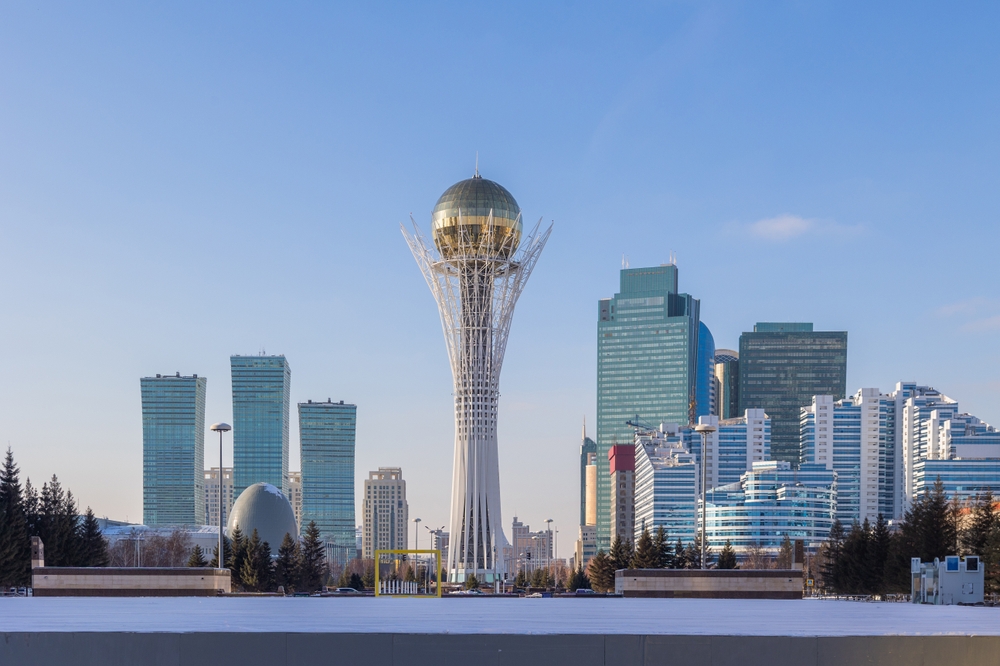
Kazakhstan is opening the door, to what President Tokayev describes as “new oil”, and going after mineral mining investment and is actively drawing up a plan for the development of this extremely lucrative sector. At the same time, stronger and stronger trade ties with China and other neighbours are bringing optimism right across the board. His ambition to make his nation the economic, trade and transit hub of Central Asia is now so close he can almost touch it and we think we can see it just over the horizon. Kazakhstan’s future continues to be bright. Tokayev is keeping his head when it appears that, at times, those around him are losing theirs. We do not see that changing.
SCO. Kazakhstan will host the Shanghai Cooperation Organisation (SCO) summit on 3rd and 4th July in Astana. Heads of state and government from 16 countries will be in attendance: India, Iran, Kazakhstan, China, Kyrgyzstan, Russia, Tajikistan, Uzbekistan, Pakistan, Belarus, Mongolia, Azerbaijan, Qatar, UAE, Turkey and Turkmenistan. Anticipate the Belarus, which is currently classified as an ‘observer’ member state, will see its position elevated. Also anticipate that Indian Prime Minister Narendra Modi will skip the summit to keep on the sweet side of the USA.
Referendum. Tokayev has announced a referendum will be held in the autumn when people will be able to have their say on the construction of a new nuclear power plant. An exact date for the poll is yet to be confirmed. The government is keen to be seen to be able to provide a strong and stable electricity supply so expect that the ‘yes’ lobby will be fully mobilised. Those opposed to the plans will cite regular and significant seismic shifts in the country and focus on the risks associated with putting a nuclear facility anywhere near a potential earthquake. Risk vs. reward. The nation will decide. We think it is highly likely that the vote will be ‘Yes’. We then expect France, China, South Korea and Russia to bid for the reactor construction contract.
Sanctions. European Union Sanctions Envoy David O’Sullivan visited Astana in June. He praised Kazakhstan’s efforts to curb sanctioned exports to Russia via Kazakhstan. Kazakhstan has been closely watched by the EU and had been threatened with secondary sanctions in the not too distant past should trading with Moscow be detected. Eager to stay on the right side of the Union, at that time, Tokayev instructed his government to take strong actions to remain in compliance with EU directives. These measures appeared to have worked. However … Since Mr O’Sullivan’s visit, the U.S. government has put the Kazakh firm KBR-Technologii on its sanction list. It is accused of illegally supplying drone components to Russia. With this announcement the EU took another look and has also updated its sanction list. It now too includes a company from Kazakhstan, Da Group 22, which the EU says has been supplying microchips to Russia. Kazakhstan needs to seriously tighten its grip in this area. It cannot afford to face the wrath of either the EU or the USA.
Floods. Crisis management of the damage done by floods continues. So far more than 67,000 people have returned home but almost 4,000 more remain in evacuation centres. But as a weather warning of heavy rains hitting 14 regions of the country in coming days, rehabilitation work will be hampered and yet more problems could surface. Currently, government assessors report that 9,306 houses require repairs and 8,290 must be condemned and demolished. Best estimates put the cost of restorations at USD550 million. So far, compensation for restoration and repair has been paid out to 6,176 families totalling USD85.5 million.
Trade. Deputy Prime Minister Serik Zhumangarin met in Urumqi with heads of seven of the largest companies in China. CITIC Construction, Xinjiang Tianye Water Conservation and Irrigation, COFCO Sugar Holding, Debont Agriculture Machinery, Jinymeng, CNCEC and Baosheng International Co. are all actively seeking Kazakh partners and are said to be keen to launch major projects. Among them will be a grain processing plant in Almaty region. Construction of the 300,000 tonne facility will begin in 2025. Kazakhstan and China have also teamed up with Belarus to develop a joint terminal and logistics services which will handle goods transported between China and Europe. It will be constructed on the Belarus/Poland border, in the town of Svislach, giving quick and clean access to and from the EU. This agreement comes amid deteriorating relations between Belarus and the West. The announcement of the new terminal coincided with the EU approving new sanctions targeting Belarus aimed at curbing Russia circumventing sanctions. Despite this we do not anticipate it will impact the growth of freight volumes along the China – Europe route. In fact, as details of the three nations’ plans to implement a new a single digital platform (SDP) for container shipping on the route it will, in fact, enhance it. The SDP will simplify customs clearance and e-commerce process not only for the three collaborating states but other nations too.
Mining. In other efforts to attract investment, particularly in the mining sector, the country has declassified Soviet era maps of fields of indium, scandium, vanadium, thallium, gallium and other rare earth elements and metals. This tactic has been used successfully before, in both 2021 and 2023, and we anticipate it will be used again. In conjunction with this the government has also drafted a national infrastructural plan aimed to make the more remote or difficult to reach regions more attractive. The plan includes upgrades to the power grid and water supply infrastructure. For the locations marked as the most important it also includes the construction of railroads to sites. Once actioned it is expected to be completed by 2029. Already a website has been launched which gives users free access to geological information and business processes related to their potential investments. Still very much in its beta phase the site is expected to add features and tools and will be completed by the end of the year. Despite that the government’s plan seems to be working. Already it has issued 2,577 licenses for exploration and 148 licenses for solid mineral production. The World Bank estimates that there are more than 5,000 unexplored fields in Kazakhstan valued at more than USD46 trillion.
Railways. As the push for income and infrastructure improvements continues the government is also now considering the privatisation of Kazakh Railways (KTZ). KZT’s finances have been in the red for years and it is now at the very real risk of bankruptcy. We do see this privatisation happening and we are marking 2025 in our calendar as the year it will take place. Anticipate that as plans to privatise are announced, two separate portfolios will be put on the table: rail operation and infrastructure management. By splitting roles and responsibilities it will take the current KZT charters out of the single basket they have been resting in, making it a much safer bet.
Numbers. Crude oil production decreased in May. OPEC reported 1.5 million barrels per day, down from 1.7 million in the previous month. Conversely, natural gas production increased in the first five months of this year up to 25.8 billion cubic metres – up 5.2% compared to the same period last year. Kazakhstan’s natural gas prices are the lowest in the world; with consumers paying USD0.07 per metre³ but recent government announcement looks like a 20% increase is extremely likely.
Crypto. AnchorX, a Hong-Kong-Based fintech company, has signed two Memorandums of Understanding with Kazakhstan to explore partnership opportunities along the Belt and Road routes. One MOU is with the Astana International Financial Centre Authority (AIFCA), the other is with Aral Petroleum Capital, a leading oil and gas company in Eastern Kazakhstan. The British fintech start-up Revolut has announced that it will cease the provision of most services in the country from 20th July 2024. The company has informed its Kazakh clients that after that date their accounts will only be available for sending and exchanging crypto currencies.
Kazakhstan will upgrade all border checkpoints amid plans to not only improve efficiency but also boost security and cut down on corruption. The Finance Ministry’s State Revenue Committee has introduced an electronic queue system at all vehicle checkpoints. This system will also automate the issuance of foreign permit forms at the borders with China and Uzbekistan. This will increase capacity for legitimate uses – each permit is linked to one vehicle only and cannot be transferred or sold. This will free up border patrol officers to monitor people movement, malicious intent or human trafficking giving the country greater control of it borders. China has already said it will increase “law enforcement and security” cooperation with Kazakhstan and help oppose interference by “external forces“. Although not implicitly stated, China does not only mean trade routes. In recent days President Xi Jinping in a call with Tokayev assured his counterpart that China resolutely opposed any force destabilizing Kazakhstan. No doubt President Putin heard.
The work needed to develop the nation’s transport infrastructure, as well as create new investment and trade opportunities, is now going full steam ahead. The near term goal is to attract USD150 billion of foreign investment in the next five years. If achieved it will double the nation’s GDP. It seems the potential gains for Kazakhstan at the moment are almost limitless. We have no doubt that Russia will, on occasions, flex its muscles in Astana’s direction but in reality it is much too busy in Ukraine to do much damage. Tokayev continues to build a buffer around his nation to protect it from the bumps and bruises of international events